In the mid 2000s, Trinidad & Tobago was having a cultural and economic (and pretty queer!) boom. Alice Yard and CCA7 were two vibrant contemporary art centers. Young artists were being influenced and mentored by the likes of the great Pat Bishop, Irenée Shaw, Christopher Cozier, Peter Doig, Che Lovelace, Sean Leonard, Meiling, Anna Serrao, Lari Richardson and Peter Minshall, just to name a few. It was in this context of artistic vibrancy that Felisha Carénage and I met at The University of the West Indies’ (UWI) quiet little satellite campus on Gordon St. in St. Augustine. Now a practicing professional painter and performance artist based in both Berlin and London, after beginning her tertiary education at Howard University in 2005, Carénage graduated from UWI in 2010 and moved to France in 2010. In 2013 she moved to Kiel, Germany, learned German and completed her masters in fine arts in 2017 at Muthesius Academy of Art and Design. She went on to participate in multiple post graduate programs and projects.

Felisha Carénage, (c) Damian Charles / Dekoloniale 2024
While she works with painting, sculpture and poetry, she also creates site specific performances for Moko Jumbies (stilt walkers). These pieces, especially, underscore her understanding of matters of mobility – the politics of travel, gender performance and class conflicts inherent to creole societies – as inherent to artmaking.
City walks or tours are common in most European cities and often reinforce the city’s beauty and oral histories – Carénage’s work locates a carnivalesque between these centers of power and the lands and cultures decimated by their colonial past and neo-colonial, capitalist present. Personal histories, songs in Haitian kreyòl, city walks; pulling these seemingly disparate elements, these loose ends, together and weaving historic and present day ideas into theater and moving sculpture is what excites me about Carénage’s work.
(c) Damian Charles / Dekoloniale 2024
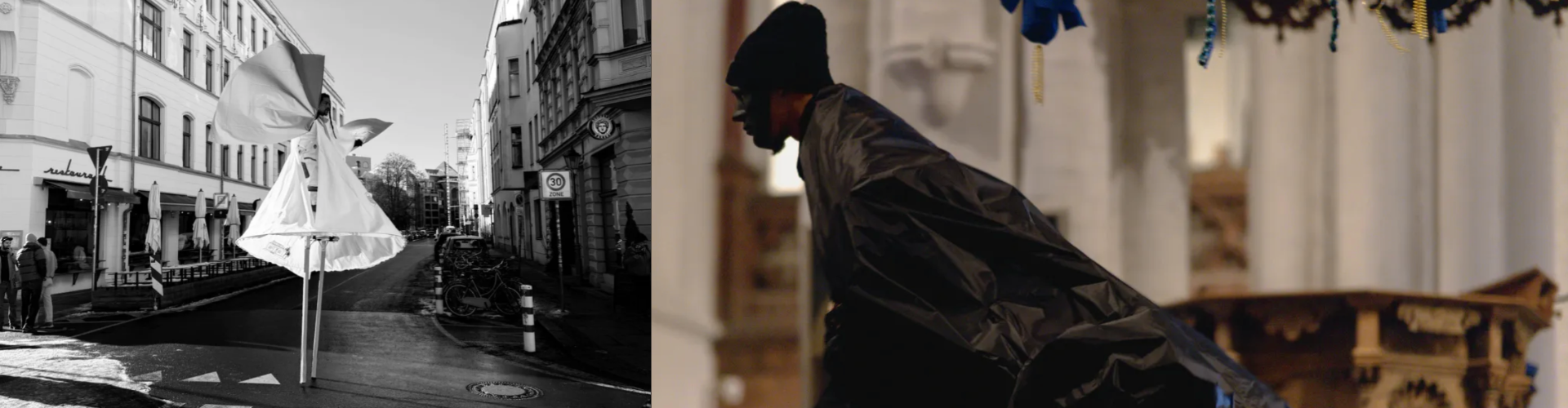
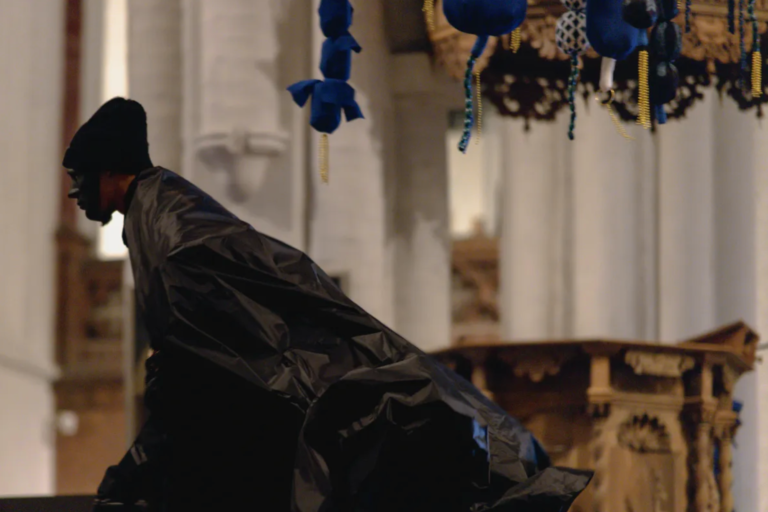
In Carénage’s Dreamer and Goner (2024) two Mokos – Tekel Sylvan and Earl Ward, Jr. – performed a 3-day-long intervention in the Berlin Wedding and Berlin Mitte neighbourhoods, within the frame of Dekoloniale, a landmark Berlin-based project which advocated the inclusion of Germany’s colonial history in its famed ‘memory culture’. For Carénage, Dreamer and Goner referenced the sinking of the SS El Faro off of the coast of Puerto Rico in 2015, a tragic event which highlighted the continued use of historical Atlantic shipping routes, and invoked the myth of John Canoe, ostensibly the ‘first’ Moko Jumbie in the Caribbean, who walked across the Atlantic from West Africa (likely what is now known as Togo or maybe Ghana).
In Trinidad carnival, incredibly talented and passionate Moko Jumbies and devils descend upon towns and cities enthralling adults and driving terror into young children (my 6 year old self has never quite recovered). They invade the streets; Mokos float over rooftops and perch on the highest walls while devils prowl the streets and can only be appeased by the donations of onlookers. Carénage brings this invasion, thousands of miles away from downtown Port of Spain, or Cedros, or Laventille, or San Fernando (where she went to primary and secondary school), to one of Western Europe’s biggest and affluent cities. And at least symbolically, captures the town.
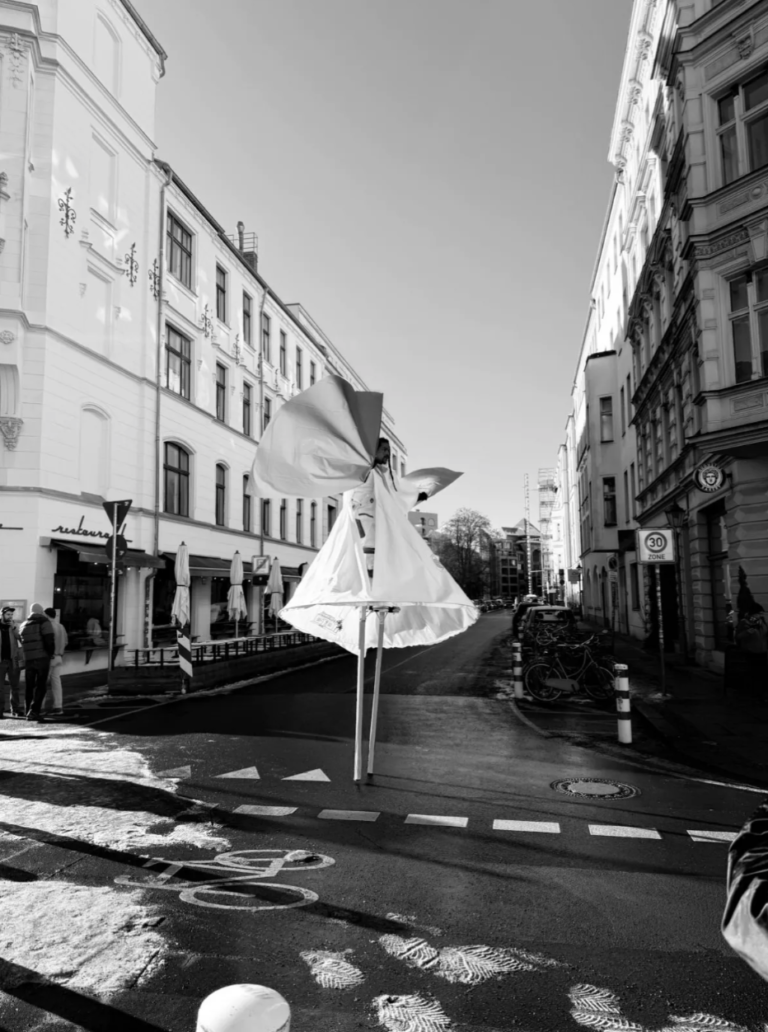
Yellow Bird, 2026. Photo: Akiel Gallina
Earlier this year, Carénage’s Yellow Bird (2026), as in Dreamer and Goner, featured a Moko on the streets of Berlin, this time referencing calypsoes and the song Choucoune, originally sung in kreyòl ayisyen but better known in the English-speaking Caribbean as Yellow Bird. She sang the English version, which her mother had taught her, as well as the Haitian creole version, in order to ‘call out’ a Moko Jumbie. That Moko was Jhawhan Thomas of Peter Minshall’s Callaloo Company – the first Moko that Carénage had ever seen up close, when Thomas was the king of the carnival band where she was working in the nighttime and on weekends while attending UWI in 2007. That feeling of dread and belonging is at the core of her performances.
Like the invading Mokos and devils of carnival, Carénage is taking over towns, not claiming but reclaiming narrative and space. Her work is a reminder that empire and hierarchy as we know it today was built on the backs of stolen lands and cultures and that human life matters even as your attention drifts and you forget your own place in this thing called history.
This month, Carénage has been touring with Charlo Alfonso and Dylan Yuk Low from Jaiso Mokos, part of Lost Tribe Carnival’s Talent Bank, in a series of performances called Evening Ragas.