Ingrid Jones is one of Canada’s fastest-rising curators. Her curatorial practice examines the intersections of decolonial curatorial practice, transnational art, and the politics of museum representation. Some of her exhibitions and collaborative projects include Labour (2024–2026), Liberation in Four Movements (2024), Nostalgia Interrupted (2022), Wild Rose (2018), and I and the DEALR (2022), a project where six artists created new works through skill-sharing and collaboration, culminating in an online exhibition.
We sat down with Jones to talk about her practice, as well as her show Labour, which was first shown in 2024 in Toronto and brought back a second time in Montreal this February.
Adam Williams – Forgive me, but I need to start with a dumb question—what is curation?
Ingrid Jones – There are many definitions. For me, curation is the combination of rigorous research, the stewardship and care of objects, and collaboration with artists, culture workers, etc., to tell stories through art.
AW – Like anthropology, is it a field born out of European modernism? Like anthropology, what about its history should people be aware of?
IJ – Curation as we know it today has its roots in the world’s fairs and expos of the 17th and 18th centuries. This includes displaying colonized peoples in human zoos. The remnants of that colonial mindset are still embedded within many cultural institutions today.
AW – What drew you to it? Coming from editorial and being a creative director, I can see a lot of cross-over.
IJ – I worked in the commercial world telling stories for a different purpose, and it wasn’t feeding my soul. I was also one of only a few Black art/creative directors, and discrimination was rampant. I was moonlighting in fine arts, doing collaborative projects after work, and it made sense, with my skills, to move toward curation. After doing an initial stint at Node, which honed my research skills, I knew this was what I wanted to do in the future—use curation to address issues most pressing to BIPOC communities.
AW – When you left the commercial world for the arts, were you surprised to encounter discrimination again?
IJ – Yes, because the arts have a facade of being liberal and progressive. I wasn’t so much surprised as disappointed to encounter resistance to progressive ideas and alternative ways of thinking and doing.
AW – Labour was first shown in 2024 in Toronto and then shown again earlier this year in Montreal. Are they the same show, or were adjustments made? If they were different, how was the story changed?
IJ – The Justina Barnicke Gallery at the Art Museum was a smaller space, so when Labour moved to the Leonard and Bina Ellen Gallery in Montreal, we had to rethink the exhibition design for a larger gallery—a good problem to have. For example, with Kosisochukwu Nnebe’s video piece an inheritance / a threat / a haunting, the monitors weren’t mounted on the wall as in Toronto; instead, they were hung with black-painted wire to make them appear as though they were floating. Displaying the work differently didn’t affect the show’s narrative—it just gave the pieces more room to breathe.
AW – One of the biggest takeaways I had from your essay was the idea of creating one’s own institutions. Can you talk a little bit more about that? Are there examples in which you and your interests are doing that?
IJ – Many artist-run centres and small galleries are doing amazing work rethinking what an art space can be and what collaboration means beyond the boundaries of large institutions. The problem these days is there’s much less funding for these spaces to do that work. I’m sure you know how it is to run a space when budgets are shrinking. One space that comes to mind is “It’s Ok,” which offers a lot of amazing programming for Black artists and arts workers.
AW – I want to ask a little bit more about how Labour compares to Liberation in Four Movements. Would you say Labour builds on it? LFM has four very distinct parts—they seem very linear to me.
IJ – Liberation in Four Movements was non-linear—the viewer could move in any direction because all themes were interconnected. Labour is a continuation of my practice of exploring systemic discrimination and our responses to it, be that rage, refusal, care, joy, etc.
AW – Before we end, I want to ask you about the state of affairs in the world right now. With the MAGA movement in the U.S., right-wing populism across Europe and Latin America, genocides in both the Middle East and Africa, and our current Canadian prime minister pursuing a capitalist, extractionist, and pro-military agenda, how do you feel about the march toward gender and racial equality at the moment?
IJ – We are so divided right now—it’s hard to say. I have hope that things will get better after the storm, but it seems we have a ways to go before we get there.
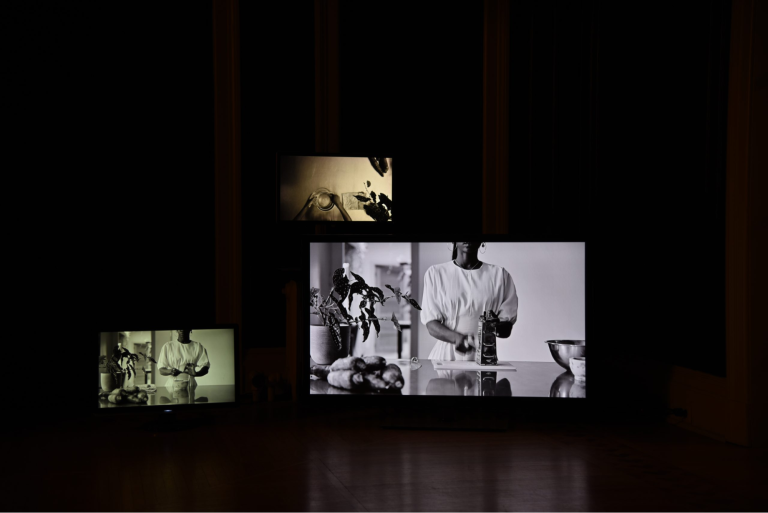
Kosisochukwu Nnebe, an inheritance / a threat / a haunting
Image Courtesy of the artist
About the curator
Ingrid Jones’ career has covered a wide range of disciplines from gallery curation, scholarly research into black identity and struggle as well as being the creative director of a print, fashion magazine. I first worked with Jones when she curated a group of 6 artists, including myself, back in 2021 for the DEALR project. We were all paired together and each pair worked collaboratively for 3 months on their projects which culminated in an online exhibition. Jones is currently a PhD candidate at the University of Toronto in curatorial studies.