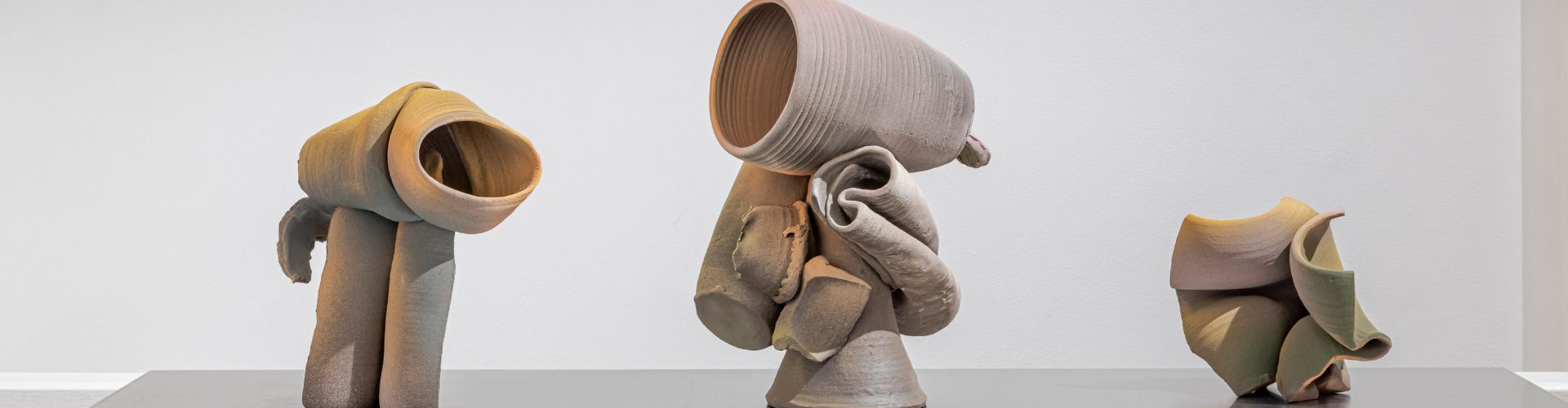
At Artist Project 2026, Clay Space Studio technician Joshua Lue Chee Kong presents Future Relics, an ongoing series developed over the past six years. In a setting largely driven by sales, his presentation shifts the focus away from commercial objects and toward a more reflective, process-based body of work. The booth reads less like a marketplace and more like an unfolding archive. His approach was recognized at the fair, where he received the Standing Ovation Award, honoring excellence in sculpture and free-standing works.
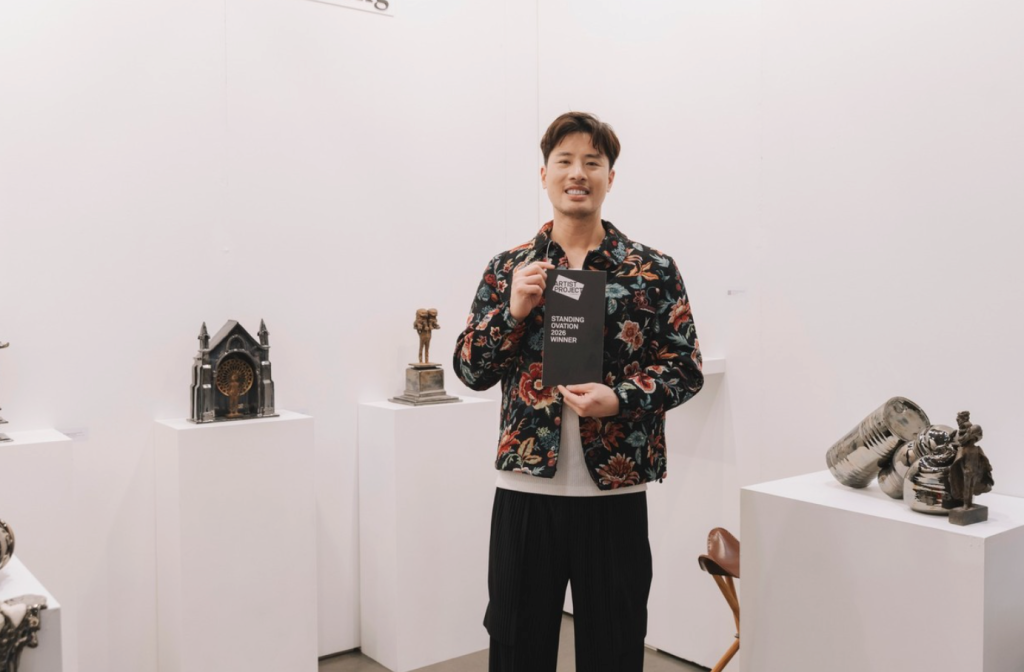
Photo credit: Artist Project
Future Relics explores diasporic identity, ancestry, and the idea of home as something fluid rather than fixed. Drawing from his experience as a Trinidadin with Hakka Chinese heritage, Joshua’s work reflects the layered nature of Caribbean culture, where identities are shaped through the mixing of histories, languages, and migration. This thinking extends into his materials. Traditional techniques such as ceramics and bronze casting are combined with 3D scanning and 3D printing, creating a dialogue between past and present.
At the center of the series is the body as a site of memory. By using casts and scans of his own form, Joshua treats the body as an archive that carries traces of inheritance, movement, and change. These forms move between the personal and the collective, suggesting how diasporic identities are shaped across generations.
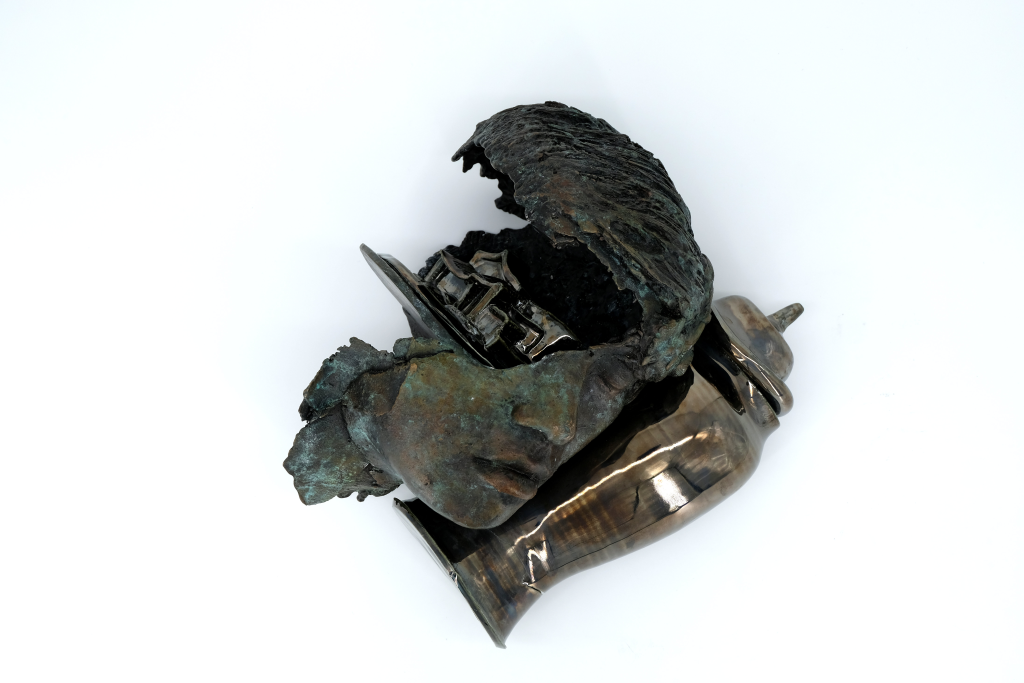
Thoughts of Home by Joshua Lue Chee Kong
One of the most striking works, Thought of Home, brings this internal landscape into focus. A large hollow bronze head rests on a Chinese vase, its surface cracked and incomplete. From these openings, ceramic forms spill outward and drip onto the base. These “thoughts” include miniature versions of the artist, alongside symbols such as seashells and dragons. Inside the head, a small sculptural scene references his mother’s village, creating a layered sense of interiority. The work visualizes how ideas of home are built from fragments of memory, culture, and imagination, held together yet never fully resolved.
In The Collapse of History, the focus shifts outward to the weight of cultural inheritance. A bronze self-portrait stands at the center, depicted as a masquerader figure. He wears a cape made from fragments of his own face, suggesting an identity formed through accumulation and reconstruction. A dragon sits on his head, pointing to lineage and heritage.
Around him, three ceramic structures appear mid-collapse. Each carries a specific reference. The oil drum connects to the steel pan and Caribbean cultural history. The Chinese ginger jar speaks to migration and tradition. The bottle of rum reflects the legacy of colonial economies in Trinidad. As these forms fall toward the figure, he remains still. The work captures a moment of pressure, where multiple histories converge, and reflects the endurance required to hold them.
Presented within the context of an art fair, Future Relics offers a quieter, more contemplative experience. Rather than presenting individual works as finished products, Joshua Lue Chee Kong frames them as part of an ongoing process. The result is a body of work that invites viewers to consider how identity is formed over time shaped by history, carried through the body, and continuously redefined.
Through Future Relics, themes of queerness, colonial legacy, and migration come into focus as forces that shape both struggle and growth. In Joshua Lue Chee Kong’s work, these histories are carried with a sense of assurance, revealing a confidence that emerges from embracing complexity rather than resolving it. It is this clarity that resonates, prompting a deeper reflection on how generational histories continue to inform who we are becoming.
About the artist
Joshua Lue Chee Kong (b. 1988) is an interdisciplinary artist, archivist, and researcher from Port of Spain, Trinidad and Tobago, currently based in Toronto, Canada. His practice investigates Caribbean histories of creolization, migration, and material culture, examining how layered colonial, diasporic, and vernacular narratives shape identity, memory, and the social fabric of the Caribbean region and its global extensions.
Working across ceramics, sculpture, photography, digital media, and archival methodologies, Kong engages processes of casting, imprinting, and preservation as conceptual tools. His work frequently explores the body as an archive, materializing memory through clay, bronze, resin, and digitally mediated forms and interrogates systems of extraction, trade, and cultural transmission across the Atlantic world. Recent bodies of work expand his interest in speculative archives, reliquary forms, and food memory as vessels of inherited knowledge and diasporic survival.
Kong received his BFA in Graphic Design from the Savannah College of Art and Design and his MFA in Interdisciplinary Art, Media, and Design from OCAD University. He has participated in artist residencies at Red Gate Gallery, Beijing (2015), and Vermont Studio Center, Vermont (2017). At Medulla Art Gallery, Trinidad, he presented two solo exhibitions, Moulded Memories (2014) and Paradise (2016).
His work has been published in Asian Diasporic Visual Cultures and the Americas, ANNO, See Me Here: A Survey of Contemporary Self-Portraits from the Caribbean, and The Draconion Switch e-magazine. In 2012, two of his photographic works appeared on the cover of TIME magazine (August issue). Alongside his studio practice, Kong is actively engaged in community-based research, mentorship, and collaborative projects that foreground collective memory-making and alternative archival practices within diasporic communities.